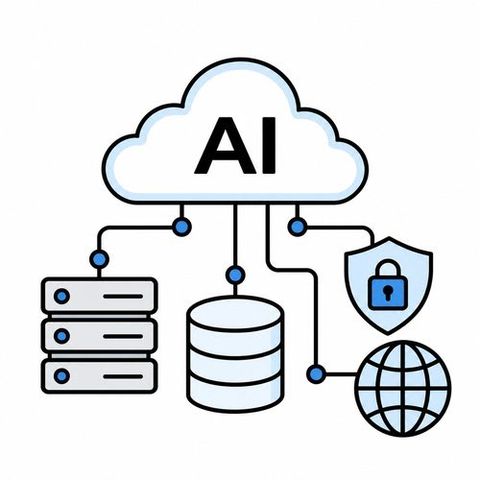
AI is already generating infrastructure code, optimizing cloud resource allocation, and auto-scaling GPU clusters. Here's what that means for your career and what to do about it.
AI won't replace AI cloud engineers, but it's automating parts of the work like boilerplate Terraform, routine debugging, and configuration tuning. Demand is surging as every company races to deploy AI workloads at scale. Architecture judgment, cost accountability, and cross-team coordination remain irreplaceable.
TASK LEVEL RISK
Most of the work stays human. AI assists at the edges.
AI is handling specific tasks. The core role is intact but shifting.
AI is automating significant portions of the work. Adaptation is essential.
 Higher risk
writing boilerplate IaC, generating YAML manifests, drafting CI/CD pipelines, log analysis, routine cost reports, documentation drafts
Lower risk
designing multi-region AI architectures, negotiating vendor contracts, security incident response, capacity planning, cross-team coordination, compliance decisions
AI cloud engineering requires system-level tradeoffs, security accountability, and organizational context that AI copilots cannot reason about independently or safely.
WHAT YOU SHOULD DO
Skills to build for the AI era
New skills - Adapt to the AI landscape
 New skills - Adapt to the AI landscape
Deploy and monitor models using tools like Kubeflow, MLflow, SageMaker, and Bedrock across training and inference pipelines.
Provision and optimize H100, A100, and TPU clusters with tools like Slurm, Ray, and NVIDIA Triton for AI workloads.
Model and control AI infrastructure costs across training and inference using tagging, quotas, and workload routing strategies.
Deploy Pinecone, Weaviate, or pgvector at scale, tuning indexes and retrieval latency for RAG systems in production.
Timeless skills - What AI can't replicate
 Timeless skills - What AI can't replicate
Weigh latency, cost, security, and reliability tradeoffs holistically, choosing solutions that fit business context and team capabilities.
Translate between ML researchers, security teams, finance, and executives to align cloud decisions with real organizational priorities.
Take accountability during outages, coordinate calm responses under pressure, and drive blameless postmortems that improve systems.
THE FULL PICTURE
What AI can do, what it can't, and where the career is headed
What AI can already do
- Generate Terraform and Kubernetes manifests from prompts
- Recommend GPU instance types for model workloads
- Auto-tune autoscaling and batch scheduling policies
- Summarize CloudWatch and Prometheus logs for anomalies
- Draft runbooks and postmortem templates
- Optimize inference cost through routing suggestions
What AI can't do
- Own accountability when a production AI pipeline fails at 3am.
- Negotiate cloud committed-use contracts based on business roadmaps.
- Make ethical tradeoffs around data residency and model deployment.
- Build trust with security, ML, and finance teams during migrations.
- These are the core contributions of AI cloud engineers, and they remain entirely human.
AI cloud engineers are among the most future-proof technical roles, since the AI economy runs on the infrastructure they build.
Do you have the right strengths for this career?
Our test measures your personality and strengths — and shows how you match with 1600+ careers.
Job outlook
BLS projects cloud and computer network architect roles growing 13% from 2024 to 2034, much faster than average. Demand is strongest in enterprises deploying generative AI and large-scale ML platforms. Specialists in GPU infrastructure, MLOps, and multi-cloud AI architecture have the strongest prospects.