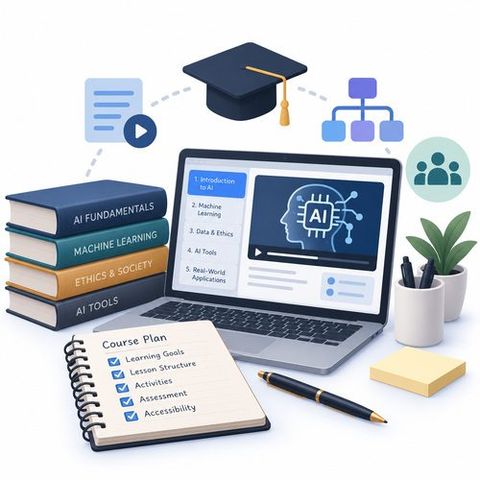
AI is already drafting lesson objectives, generating assessment questions, and personalizing learning paths. Here's what that means for your career and what to do about it.
AI won't replace curriculum designers, but it's already replacing some of the routine work they do. Tools like ChatGPT and Khanmigo now handle first-draft content, rubric creation, and alignment checks in minutes. Pedagogical judgment, learner empathy, and ethical framing remain irreplaceable.
TASK LEVEL RISK
Most of the work stays human. AI assists at the edges.
AI is handling specific tasks. The core role is intact but shifting.
AI is automating significant portions of the work. Adaptation is essential.
 Higher risk
drafting learning objectives, generating quiz questions, aligning content to standards, formatting course modules, writing lesson summaries, creating rubric drafts
Lower risk
designing pedagogical strategy, evaluating learner outcomes, negotiating with stakeholders, integrating AI ethics, adapting for diverse learners, piloting new instructional models
Curriculum design requires understanding real learner struggles, cultural context, and ethical tradeoffs in AI education that generative models cannot authentically resolve.
WHAT YOU SHOULD DO
Skills to build for the AI era
New skills - Adapt to the AI landscape
 New skills - Adapt to the AI landscape
Craft effective prompts for tools like ChatGPT and Claude to generate pedagogically sound content and assessments.
Assess edtech AI products for accuracy, bias, privacy compliance, and alignment with learning objectives across grade levels.
Interpret data from adaptive platforms to refine curriculum, using tools like Power BI and LMS dashboards.
Develop guardrails for student data, academic integrity, and equitable AI access within institutional policies.
Timeless skills - What AI can't replicate
 Timeless skills - What AI can't replicate
Decide when direct instruction, inquiry, or practice best serves specific learners in specific contexts.
Understand cognitive, emotional, and cultural realities that shape how students actually engage with material.
Align teachers, administrators, parents, and technologists around shared curricular goals despite competing priorities and concerns.
THE FULL PICTURE
What AI can do, what it can't, and where the career is headed
What AI can already do
- Draft learning objectives aligned to standards
- Generate assessment items and answer keys
- Personalize content pathways based on learner data
- Summarize research on instructional methods
- Produce multilingual content variants quickly
- Suggest rubric criteria for common tasks
What AI can't do
- Understand the lived experience of struggling learners in a specific classroom.
- Make ethical decisions about how AI should be introduced to children.
- Build trust with teachers, administrators, and skeptical parents.
- Judge when a curriculum needs to be scrapped and rebuilt.
- These are the core contributions of AI Curriculum Designers, and they remain entirely human.
AI Curriculum Designers who master both learning science and AI tools will lead the next decade of education innovation.
Do you have the right strengths for this career?
Our test measures your personality and strengths — and shows how you match with 1600+ careers.
Job outlook
The BLS projects instructional coordinator roles to grow 2 percent from 2024 to 2034, with AI-focused specializations growing much faster. Demand is strongest in K-12 districts, corporate L&D, and edtech companies rolling out AI tools. Designers who combine learning science with AI literacy have the best prospects.