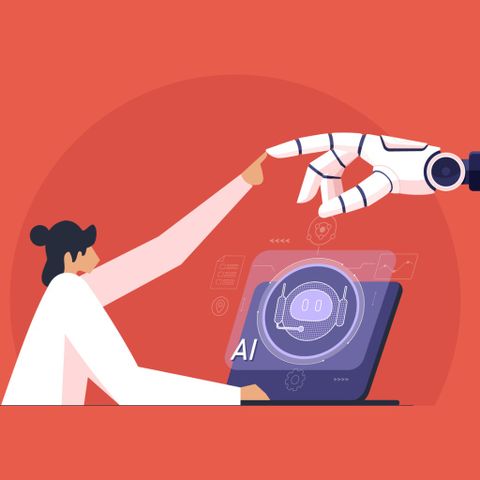
AI is already generating interface mockups, drafting conversational scripts, and testing prompt variations. Here's what that means for your career and what to do about it.
AI won't replace AI Interaction Designers, but it's reshaping the daily craft. Companies now need specialists who can design trust, transparency, and graceful failure into AI-powered products. Empathy, ethical framing, and cross-disciplinary judgment remain irreplaceable.
TASK LEVEL RISK
Most of the work stays human. AI assists at the edges.
AI is handling specific tasks. The core role is intact but shifting.
AI is automating significant portions of the work. Adaptation is essential.
 Higher risk
generating wireframe variations, drafting sample prompts, running A/B test analysis, writing baseline microcopy, producing usability heuristics reports
Lower risk
user research interviews, ethical framework design, stakeholder alignment, novel interaction concepts, trust-building patterns, handling edge case failures
This role depends on human empathy, ethical judgment, and the ability to anticipate how real users emotionally respond to AI systems.
WHAT YOU SHOULD DO
Skills to build for the AI era
New skills - Adapt to the AI landscape
 New skills - Adapt to the AI landscape
Crafting natural dialogue flows for chatbots and voice agents using tools like Voiceflow, Botmock, and structured intent modeling frameworks.
Designing effective system prompts and evaluation tests for LLMs like GPT-4, Claude, and Gemini across diverse product contexts.
Measuring model outputs using rubrics, human raters, and automated evals to catch hallucinations, bias, and unsafe responses systematically.
Applying frameworks from Google PAIR, Microsoft HAX, and IEEE to build transparency, consent, and graceful failure into AI experiences.
Timeless skills - What AI can't replicate
 Timeless skills - What AI can't replicate
Understanding emotional context, unspoken needs, and cultural nuance during user research that no model can replicate authentically.
Weighing tradeoffs between engagement, safety, and user wellbeing when AI product decisions carry real human consequences.
Seeing how AI features interact with organizational incentives, regulations, and downstream user behavior across complex product ecosystems.
THE FULL PICTURE
What AI can do, what it can't, and where the career is headed
What AI can already do
- Generate conversational flow variations quickly
- Draft prompt templates and system messages
- Analyze user interaction logs at scale
- Produce interface mockups from text descriptions
- Summarize usability testing transcripts
- Suggest microcopy improvements based on tone rules
What AI can't do
- Interview users and interpret emotional subtext during live conversations.
- Make ethical tradeoffs when AI outputs could harm vulnerable users.
- Build organizational consensus around risky AI product decisions.
- Anticipate cultural and contextual failures no dataset has seen.
- These are the core contributions of AI Interaction Designers, and they remain entirely human.
AI Interaction Designers will define how millions of people trust and rely on AI, making this one of the most durable design disciplines of the next decade.
Do you have the right strengths for this career?
Our test measures your personality and strengths — and shows how you match with 1600+ careers.
Job outlook
The BLS projects digital designer roles, which include AI Interaction Designers, will grow about 8 percent from 2024 to 2034. Demand is strongest at AI product companies, enterprise SaaS firms, and healthcare technology. Specialists in conversational AI, agent design, and responsible AI patterns have the strongest prospects.