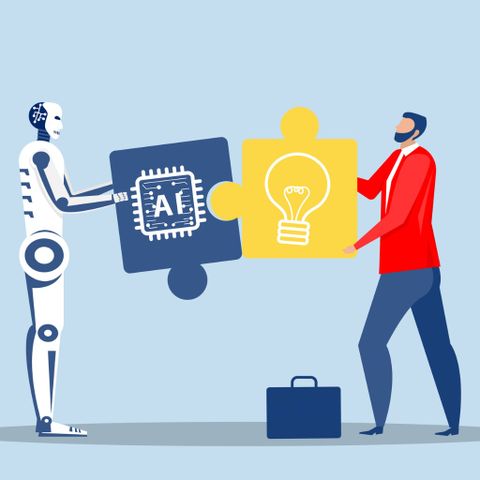
AI is already generating control code, simulating robot behavior, and optimizing motion planning algorithms. Here's what that means for your career and what to do about it.
AI won't replace AI robotics engineers, but it's already replacing some of the work they do. Routine simulation setup, boilerplate ROS code, and basic sensor calibration are increasingly automated. Systems thinking, hardware intuition, and safety accountability remain irreplaceable.
TASK LEVEL RISK
Most of the work stays human. AI assists at the edges.
AI is handling specific tasks. The core role is intact but shifting.
AI is automating significant portions of the work. Adaptation is essential.
 Higher risk
boilerplate ROS code, basic motion planning, simulation setup, sensor data preprocessing, documentation drafting, unit test generation
Lower risk
hardware debugging, safety certification, system architecture decisions, novel manipulator design, real-world deployment troubleshooting, cross-team integration
AI robotics engineering requires physical debugging, cross-domain integration judgment, and accountability for safety-critical systems that AI cannot autonomously verify or own.
WHAT YOU SHOULD DO
Skills to build for the AI era
New skills - Adapt to the AI landscape
 New skills - Adapt to the AI landscape
Fine-tuning vision-language-action models like RT-2 and Octo for robotic manipulation and integrating LLM planners into control stacks.
Using domain randomization in Isaac Sim or MuJoCo to train policies that transfer reliably from simulation to physical robots.
Applying formal methods and runtime monitors to validate learned policies against safety envelopes in safety-critical robotic deployments.
Designing reward functions, curriculum learning schedules, and distributed training infrastructure for manipulation and locomotion policies.
Timeless skills - What AI can't replicate
 Timeless skills - What AI can't replicate
Reasoning across mechanical, electrical, and software layers simultaneously to diagnose emergent failures that no single tool can fully explain.
Sensing when sensor noise, thermal drift, or mechanical backlash is the true cause of a bug rather than software logic.
Translating between mechanical engineers, ML researchers, and product stakeholders to align tradeoffs on cost, safety, and performance.
THE FULL PICTURE
What AI can do, what it can't, and where the career is headed
What AI can already do
- Generate ROS nodes and control loop scaffolding
- Simulate robot dynamics across thousands of scenarios
- Optimize motion planning trajectories automatically
- Train reinforcement learning policies for grasping tasks
- Analyze sensor logs to detect anomalies
- Suggest kinematic configurations from design constraints
What AI can't do
- AI cannot physically diagnose why a robot arm oscillates on the factory floor.
- AI cannot own safety certification or take legal responsibility for autonomous system failures.
- AI cannot negotiate hardware tradeoffs with mechanical engineers under tight budget constraints.
- AI cannot judge when a simulated policy is ready for real-world deployment.
- These are the irreplaceable contributions of AI Robotics Engineers, and they remain entirely human.
AI Robotics Engineers who master foundation models, safety verification, and hardware-software integration will lead the next decade of embodied intelligence.
Do you have the right strengths for this career?
Our test measures your personality and strengths — and shows how you match with 1600+ careers.
Job outlook
The BLS projects robotics-related engineering roles to grow roughly 9 percent from 2024 to 2034, faster than average. Demand is strongest in warehouse automation, autonomous vehicles, and surgical robotics. Engineers combining machine learning with embedded systems and manipulation have the strongest prospects.