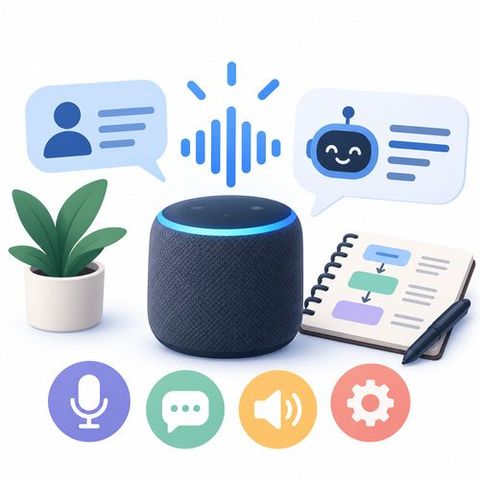
AI is already generating conversation flows, synthesizing test voices, and analyzing user speech patterns. Here's what that means for your career and what to do about it.
AI won't replace voice interface designers, but it's already replacing some of the work they do. Prototyping dialogue trees and drafting sample responses now takes minutes instead of days. Empathy, cultural nuance, and brand voice remain irreplaceable.
TASK LEVEL RISK
Most of the work stays human. AI assists at the edges.
AI is handling specific tasks. The core role is intact but shifting.
AI is automating significant portions of the work. Adaptation is essential.
 Higher risk
drafting sample dialogue, generating intent variations, transcribing user tests, producing synthetic test voices, writing basic error prompts, tagging utterance datasets
Lower risk
defining brand voice personality, ethical review of edge cases, cross-cultural adaptation, resolving ambiguous user intent, stakeholder alignment, accessibility strategy
Voice design depends on emotional attunement, cultural sensitivity, and ethical judgment about privacy and inclusion that AI systems cannot reliably provide.
WHAT YOU SHOULD DO
Skills to build for the AI era
New skills - Adapt to the AI landscape
 New skills - Adapt to the AI landscape
Coordinate multiple LLM agents, tools, and voice models to deliver coherent, reliable conversational experiences at scale.
Craft system prompts and persona specs shaping voice, tone, and safe behavior across GPT, Claude, and Gemini.
Build evaluation frameworks measuring recognition accuracy, response quality, latency, and satisfaction across diverse accents and contexts.
Design experiences blending voice with screens, gesture, and ambient signals across cars, wearables, and smart homes.
Timeless skills - What AI can't replicate
 Timeless skills - What AI can't replicate
Observe users in context, interpret unspoken discomfort, and translate emotional signals into design decisions AI cannot infer.
Craft distinctive personalities with consistent word choice, humor, and cadence that make voice products feel human.
Weigh privacy, consent, bias, and accessibility tradeoffs where automated voice decisions affect vulnerable users' real lives.
THE FULL PICTURE
What AI can do, what it can't, and where the career is headed
What AI can already do
- Generate hundreds of intent phrase variations quickly
- Synthesize realistic voice prototypes for testing
- Analyze conversation logs to surface friction points
- Draft first-pass dialogue flows from requirements
- Auto-transcribe and cluster user utterances
- Produce localized voice content across languages
What AI can't do
- AI cannot decide what personality a voice assistant should embody for a specific brand and audience.
- AI cannot judge when a conversational failure will damage user trust or cause real harm.
- AI cannot navigate cross-team politics to align product, legal, and engineering on voice standards.
- AI cannot sit with a user in testing and read the subtle discomfort that reveals a broken interaction.
- These are the core contributions of AI Voice Interface Designers, and they remain entirely human.
Voice interface designers who master AI orchestration and human-centered judgment will shape the most important interaction layer of the next decade.
Do you have the right strengths for this career?
Our test measures your personality and strengths — and shows how you match with 1600+ careers.
Job outlook
The BLS projects employment for digital interface designers to grow 16 percent from 2024 to 2034, much faster than average. Demand is strongest at consumer tech companies, automotive, and healthcare firms deploying voice assistants. Designers with conversational AI and multimodal expertise have the best prospects.