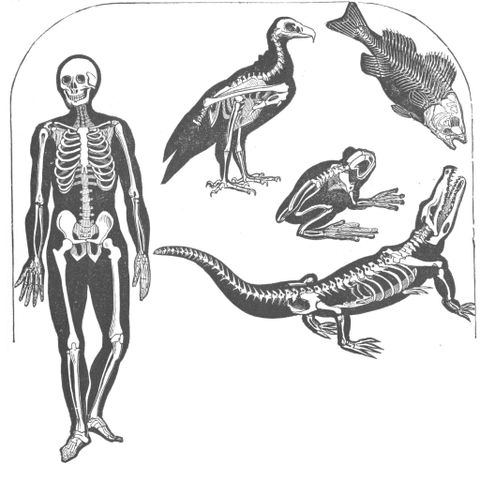
AI is already segmenting CT scans, classifying skeletal features, and mapping evolutionary relationships across species. Here's what that means for your career and what to do about it.
AI won't replace comparative anatomists, but it's already replacing some of the tedious measurement and classification work. Machine learning models now identify morphological patterns across thousands of specimens faster than any human. Hypothesis generation, specimen handling, and evolutionary interpretation remain irreplaceable.
TASK LEVEL RISK
Most of the work stays human. AI assists at the edges.
AI is handling specific tasks. The core role is intact but shifting.
AI is automating significant portions of the work. Adaptation is essential.
 Higher risk
Bone measurement, image segmentation, landmark digitization, morphometric calculations, literature searches, specimen cataloging, basic phylogenetic tree building
Lower risk
Field collection, dissection technique, evolutionary interpretation, hypothesis formation, museum specimen curation, teaching anatomy, peer review
Comparative anatomy depends on tactile specimen handling, evolutionary reasoning, and the theoretical framing of morphological questions that AI cannot originate independently.
WHAT YOU SHOULD DO
Skills to build for the AI era
New skills - Adapt to the AI landscape
 New skills - Adapt to the AI landscape
Train convolutional neural networks in Python or MorphoSource pipelines to segment scans and detect anatomical landmarks automatically.
Use tools like Avizo, Slicer, and geomorph in R to analyze shape variation across species from CT and surface scans.
Write Python and R scripts to automate measurements, run phylogenetic comparative methods, and integrate morphological with genomic datasets.
Curate and share 3D specimen data through platforms like MorphoSource and iDigBio to enable global collaborative research.
Timeless skills - What AI can't replicate
 Timeless skills - What AI can't replicate
Interpret anatomical patterns within phylogenetic, developmental, and ecological context to build hypotheses AI cannot originate independently.
Careful physical technique with rare, fragile, or fossil specimens remains foundational and irreplaceable to comparative anatomical practice.
Translate complex morphological findings into clear publications, lectures, and museum exhibits that engage scientists and public audiences alike.
THE FULL PICTURE
What AI can do, what it can't, and where the career is headed
What AI can already do
- Segment CT and MRI scans of specimens automatically
- Digitize anatomical landmarks for geometric morphometrics
- Classify species from skeletal images with high accuracy
- Run phylogenetic analyses across large morphological datasets
- Search and summarize anatomical literature rapidly
- Detect subtle shape variations invisible to the human eye
What AI can't do
- AI cannot physically dissect rare specimens or handle fragile fossil material with the care required.
- AI cannot formulate novel evolutionary hypotheses grounded in ecological and developmental context.
- AI cannot conduct fieldwork to collect new comparative material from remote habitats.
- AI cannot mentor students through the tactile intuition needed for anatomical expertise.
- These are the core contributions of Comparative Anatomists, and they remain entirely human.
Comparative anatomists who pair evolutionary insight with AI-powered morphological analysis will lead the next era of the field.
Do you have the right strengths for this career?
Our test measures your personality and strengths — and shows how you match with 1600+ careers.
Job outlook
The Bureau of Labor Statistics projects zoologists and wildlife biologists, which includes comparative anatomists, to grow 3 percent from 2024 to 2034. Demand is strongest in universities, natural history museums, and biomedical research institutions. Specialists combining morphometrics with genomics or biomechanics have the strongest prospects.