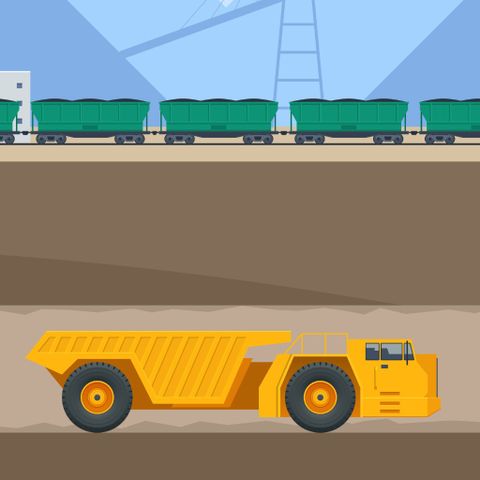
AI is already guiding autonomous haul trucks, optimizing route planning, and monitoring vehicle diagnostics in real time. Here's what that means for your career and what to do about it.
AI won't replace mine shuttle car operators overnight, but it's already automating parts of underground haulage. Major mining companies deploy semi-autonomous vehicles that reduce operator hours on repetitive routes. Situational awareness, mechanical intuition, and safety judgment remain irreplaceable underground.
TASK LEVEL RISK
Most of the work stays human. AI assists at the edges.
AI is handling specific tasks. The core role is intact but shifting.
AI is automating significant portions of the work. Adaptation is essential.
 Higher risk
fixed-route hauling, load cycle timing, basic vehicle diagnostics, GPS-based positioning, routine speed control, shift reporting
Lower risk
responding to roof falls, navigating unstable ground, coordinating with miners, handling equipment failures, emergency evacuations, hazard identification
Underground mining demands split-second hazard judgment, physical adaptability in unpredictable conditions, and accountability for crew safety that AI systems cannot reliably provide.
WHAT YOU SHOULD DO
Skills to build for the AI era
New skills - Adapt to the AI landscape
 New skills - Adapt to the AI landscape
Learn to monitor and override semi-autonomous shuttle systems from Sandvik, Caterpillar, and Komatsu using control room dashboards and telemetry.
Interpret proximity detection, LiDAR, and vibration sensor data to validate AI decisions and identify equipment failures before breakdowns occur.
Operate haulage vehicles remotely via joystick and camera feeds, essential as mines move operators from underground to surface control rooms.
Use digital hazard logging apps and predictive safety analytics to document conditions and contribute to mine-wide risk assessment models.
Timeless skills - What AI can't replicate
 Timeless skills - What AI can't replicate
Recognize subtle warning signs of roof instability, gas buildup, or equipment stress that automated systems consistently miss underground.
Coordinate seamlessly with continuous miner operators, roof bolters, and shift bosses under noisy, low-visibility, high-pressure underground conditions.
Diagnose problems by sound, vibration, and feel, catching failures that sensor arrays and diagnostic software cannot detect in time.
THE FULL PICTURE
What AI can do, what it can't, and where the career is headed
What AI can already do
- Guide shuttle cars along mapped underground routes
- Monitor engine diagnostics and predict maintenance needs
- Optimize haul cycles for maximum throughput
- Track operator hours and productivity metrics
- Detect proximity to workers using sensor arrays
- Generate automated shift and load reports
What AI can't do
- AI cannot reliably interpret sudden changes in roof conditions or ground stability.
- AI cannot physically respond to trapped equipment or coordinate rescue actions.
- AI cannot build the trust and communication needed among an underground crew.
- AI cannot exercise the moral responsibility of choosing safety over production.
- These are the irreplaceable contributions of Mine Shuttle Car Operators, and they remain entirely human.
Mine shuttle car operators who learn to supervise and troubleshoot automated haulage systems will remain valuable as mines modernize.
Do you have the right strengths for this career?
Our test measures your personality and strengths — and shows how you match with 1600+ careers.
Job outlook
The BLS projects employment of underground mining machine operators to decline about 3 percent from 2024 to 2034, slower than most occupations. Demand remains strongest in coal-producing regions and metal mining states like Nevada and Arizona. Operators skilled in automated equipment supervision and safety systems have the best prospects.