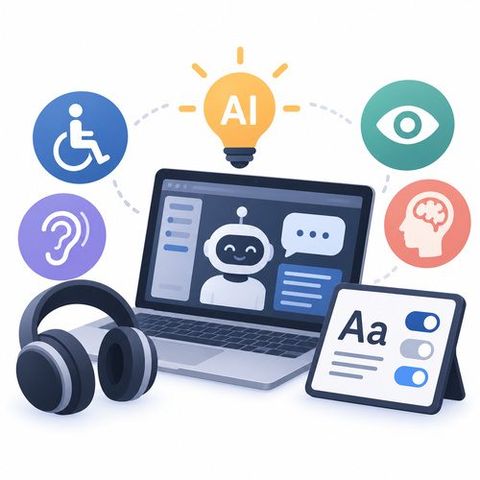
AI is already scanning interfaces for accessibility violations, generating alt text, and suggesting color contrast fixes. Here's what that means for your career and what to do about it.
AI won't replace accessibility designers, but it's already replacing some of the compliance work they used to do manually. Automated tools now catch WCAG violations in seconds, shifting the human role toward strategy and user research. Empathy, lived experience knowledge, and inclusive design judgment remain irreplaceable.
TASK LEVEL RISK
Most of the work stays human. AI assists at the edges.
AI is handling specific tasks. The core role is intact but shifting.
AI is automating significant portions of the work. Adaptation is essential.
 Higher risk
WCAG compliance scans, alt text generation, color contrast checking, basic ARIA labeling, automated screen reader testing, accessibility report drafting
Lower risk
User research with disabled communities, inclusive design strategy, stakeholder advocacy, complex interaction patterns, cross-disability testing coordination, policy development
Accessibility design requires deep empathy with disabled users, ethical accountability for inclusion, and contextual judgment that automated audits fundamentally cannot replicate.
WHAT YOU SHOULD DO
Skills to build for the AI era
New skills - Adapt to the AI landscape
 New skills - Adapt to the AI landscape
Reviewing automated scans from axe DevTools and Stark, catching false positives and identifying issues AI misses.
Testing AI-generated content, voice interfaces, and image recognition for disability bias and accessibility gaps across users.
Crafting prompts that produce accessible outputs including proper alt text, plain language, and structured WCAG-compliant content.
Applying emerging WCAG 3 cognitive guidelines and neurodivergent research methods to complex AI-driven interfaces and workflows.
Timeless skills - What AI can't replicate
 Timeless skills - What AI can't replicate
Building trust and collaborating authentically with disabled users, centering their lived expertise in every design decision.
Persuading stakeholders to prioritize accessibility investment and defending inclusive design against shortcuts and competing organizational pressures.
Understanding how blindness, deafness, motor, and cognitive disabilities interact differently with technology across the full spectrum.
THE FULL PICTURE
What AI can do, what it can't, and where the career is headed
What AI can already do
- Scan interfaces for WCAG 2.2 violations instantly
- Generate initial alt text descriptions for images
- Check color contrast ratios across design systems
- Suggest ARIA labels for common UI patterns
- Automate keyboard navigation testing at scale
- Generate accessibility conformance report drafts
What AI can't do
- AI cannot conduct empathetic usability sessions with blind, deaf, or cognitively disabled users.
- AI cannot advocate for accessibility budget and priority in executive strategy meetings.
- AI cannot judge whether a design genuinely serves lived disability experience versus technical compliance.
- AI cannot build trust with disability communities or co-design with them authentically.
- These are the core contributions of AI Accessibility Designers, and they remain entirely human.
AI Accessibility Designers who master automation tools while deepening disability community expertise will lead the next decade of inclusive technology.
Do you have the right strengths for this career?
Our test measures your personality and strengths — and shows how you match with 1600+ careers.
Job outlook
The BLS projects web developer and digital designer roles will grow 8 percent from 2024 to 2034, with accessibility specializations growing faster due to legal pressure. Demand is strongest in government, healthcare, education, and enterprise SaaS. Designers combining AI tooling fluency with disability research expertise have the strongest prospects.