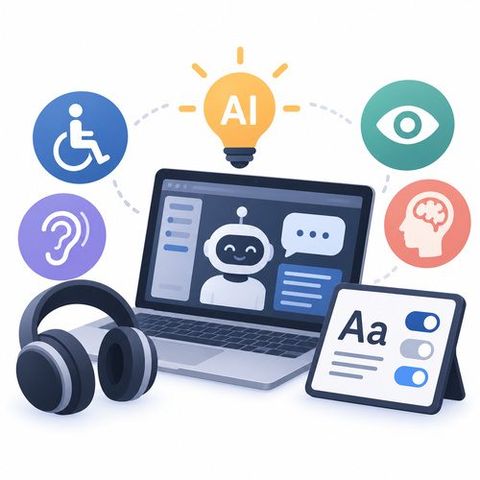
What is an AI Accessibility Designer?
An AI accessibility designer makes AI-powered products and experiences usable for everyone, including people with disabilities. They focus on creating inclusive features for voice assistants, chatbots, recommendation systems, and other AI tools, ensuring that interactions are clear, fair, and easy to navigate. By considering a wide range of user needs, these designers help AI systems work well for people with visual, hearing, cognitive, or mobility challenges.
AI accessibility designers often collaborate with UX designers, engineers, and product teams to build accessible interfaces and workflows. They apply accessibility standards, test designs with real users, and adjust AI behaviors to reduce bias and improve clarity. Their work helps ensure that AI technologies are not only functional but also welcoming, fair, and effective for a diverse audience.
What does an AI Accessibility Designer do?

Duties and Responsibilities
An AI accessibility designer focuses on making AI tools and experiences usable for everyone, including people with disabilities. Their work helps ensure that technology is inclusive, fair, and easy to interact with. Here are some key responsibilities:
- Designing Inclusive AI Experiences: Create interfaces and interactions that work for people with a wide range of abilities, including support for screen readers, voice control, and other assistive technologies. The goal is to ensure AI systems are usable and intuitive for as many users as possible.
- Testing for Accessibility Issues: Regularly test AI systems to identify barriers that could make them difficult to use, such as poor contrast, unclear navigation, or features that do not work well with assistive tools. Findings are used to improve overall accessibility and user experience.
- Improving Usability for All Users: Simplify instructions, navigation, and AI responses so they are easier to understand and interact with. This helps create clearer, more intuitive experiences across diverse user groups.
- Collaborating with Developers and Designers: Work closely with product teams to integrate accessibility considerations early in the design process. This helps prevent issues from arising later and ensures accessibility is built in from the start.
- Following Accessibility Standards: Apply established guidelines such as WCAG to guide design and development decisions. These standards help maintain consistency and ensure a high level of accessibility across products.
- Advocating for Inclusive Design: Promote awareness of accessibility within teams and organizations to encourage inclusive thinking. This helps reinforce that accessible design benefits all users, not only those with disabilities.
- Reviewing AI Outputs for Clarity and Bias: Evaluate AI-generated content to ensure it is clear, understandable, and easy to use. Also check for language or patterns that may unintentionally exclude or disadvantage certain users.
Types of AI Accessibility Designers
There are several types of ai accessibility designers, each focusing on different parts of making AI systems more inclusive and usable. Some common types include:
- Product Accessibility Designers: Product accessibility designers focus on building accessible AI features directly into products and user interfaces. They ensure that interactions, layouts, and workflows are usable for people with a wide range of abilities from the start.
- AI UX Accessibility Designers: AI UX accessibility designers specialize in how users interact with AI systems, such as chatbots, assistants, or generative tools. They work to make conversations, outputs, and user flows clear, predictable, and easy to navigate.
- Assistive Technology Designers: Assistive technology designers focus on how AI works with tools like screen readers, voice control, captions, and other assistive systems. Their goal is to ensure seamless compatibility between AI products and accessibility technologies.
- AI Content Accessibility Designers: AI content accessibility designers focus on how AI-generated text, images, and outputs are understood by users. They work on clarity, readability, structure, and making sure content is inclusive and easy to interpret.
- Accessibility Testing Designers: Accessibility testing designers specialize in identifying barriers in AI systems through structured testing. They evaluate products for compliance, usability issues, and real-world accessibility challenges.
- Ethical Accessibility Designers: Ethical accessibility designers focus on fairness, bias reduction, and inclusive outcomes in AI systems. They ensure AI tools do not unintentionally exclude or disadvantage users with disabilities or different needs.
AI accessibility designers have distinct personalities. Think you might match up? Take the free career test to find out if AI accessibility designer is one of your top career matches. Take the free test now Learn more about the career test
What is the workplace of an AI Accessibility Designer like?
The workplace of an AI accessibility designer is usually a modern office environment, but it is often flexible and hybrid. Many professionals in this role work part of the time in an office and part of the time from home. Their work is mostly done on a computer, using design tools, testing software, and collaboration platforms.
A big part of their day involves working with other teams, such as product managers, engineers, UX designers, and researchers. They join meetings to review designs, discuss accessibility issues, and suggest improvements. They also spend time testing AI products to make sure they work well with assistive technologies like screen readers or voice control.
The environment is usually collaborative and detail-focused, with a strong emphasis on problem-solving and communication. Deadlines can be tied to product launches or updates, so the work can sometimes be fast-paced. At the same time, there is a strong focus on thoughtful design, making sure AI tools are usable and inclusive for as many people as possible.
Frequently Asked Questions
Artificial Intelligence-Related Careers and Degrees
AI Careers
Technical & Engineering Roles
- AI Agent Developer
- AI Autonomous Systems Engineer
- AI Cloud Engineer
- Artificial Intelligence Engineer
- AI Infrastructure Engineer
- AI Integration Specialist
- AI Performance Engineer
- AI Platform Engineer
- AI Robotics Engineer
- AI Software Engineer
- AI Solutions Engineer
- AI Systems Engineer
- Computer Vision Engineer
- Edge AI Engineer
- Generative AI Engineer
- Machine Learning Engineer
- MLOps Engineer
- Multimodal AI Engineer
- Natural Language Processing (NLP) Engineer
- Synthetic Data Engineer
AI Product & Design Roles
- AI Accessibility Designer
- AI Creative Technologist
- AI Curriculum Designer
- AI Instructional Designer
- AI Interaction Designer
- AI Learning Experience Designer
- AI Personalization Engineer
- AI Product Designer
- AI Product Manager
- AI UX Designer
- AI Voice Interface Designer
- HAX (Human-AI Experience) Designer
AI Research & Data Roles
- AI Data Analyst
- AI Data Curator
- AI Data Scientist
- AI Evaluation Specialist
- AI Knowledge Engineer
- AI Prompt Scientist
- AI Research Analyst
- AI Research Scientist
AI Strategy, Management & Business Roles
- AI Business Analyst
- AI Change Manager
- AI Consultant
- AI Implementation Specialist
- AI Lifecycle Manager
- AI Product Evangelist
- AI Project Coordinator
- AI Strategist
- AI Workforce Transformation Specialist
AI Ethics, Policy & Governance Roles
- AI Bias Auditor
- AI Compliance Analyst
- AI Compliance Officer
- AI Data Privacy Specialist
- AI Ethics Specialist
- AI Explainability Specialist
- AI Governance Analyst
- AI Governance Specialist
- AI Policy Analyst
- AI Red Team Specialist
- AI Risk Manager
- AI Safety Researcher
- AI Security Specialist
- AI Trust & Safety Specialist
- Responsible AI Specialist
AI Content & Communication Roles
- AI Auditor
- AI Community Manager
- AI Content Writer
- AI Conversation Designer
- AI Literacy Specialist
- AI Localization Specialist
- AI Technical Writer
- AI Trainer
Generative & Creative AI Roles
Industry-Specific AI Roles
- AI Agriculture Specialist
- AI Cybersecurity Specialist
- AI Education Specialist
- AI Financial Specialist
- AI Gaming Specialist
- AI Healthcare Specialist
- AI Legal Specialist
- AI Manufacturing Specialist
- AI Marketing Specialist
- AI Retail Specialist
- AI Supply Chain Analyst
Degrees
AI Accessibility Designers are also known as:
Artificial Intelligence Accessibility Designer