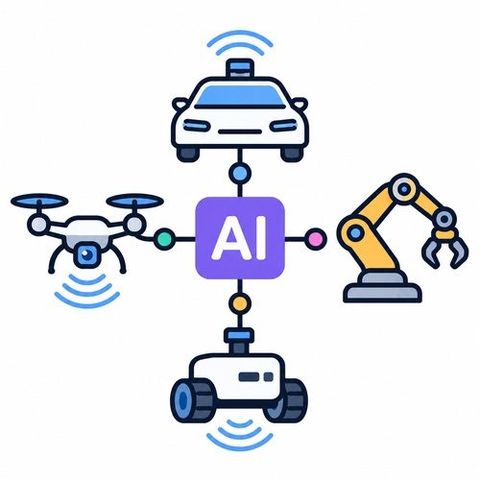
AI is already generating control code, simulating edge cases, and tuning perception models. Here's what that means for your career and what to do about it.
AI won't replace autonomous systems engineers, but it's already replacing some of the work they do. Routine simulation setup and boilerplate ROS code now take minutes instead of days. Safety judgment, system integration, and real-world debugging remain irreplaceable.
TASK LEVEL RISK
Most of the work stays human. AI assists at the edges.
AI is handling specific tasks. The core role is intact but shifting.
AI is automating significant portions of the work. Adaptation is essential.
 Higher risk
boilerplate ROS node code, standard sensor calibration routines, simulation scenario generation, log parsing, unit test creation, documentation drafting
Lower risk
safety case authoring, edge-case field debugging, hardware-software integration, sensor fusion architecture, regulatory certification, cross-team system tradeoffs
This role depends on physical-world validation, safety accountability for autonomous behavior, and cross-disciplinary judgment that AI cannot verify or own.
WHAT YOU SHOULD DO
Skills to build for the AI era
New skills - Adapt to the AI landscape
 New skills - Adapt to the AI landscape
Bridging simulation and reality using domain randomization, Isaac Sim, and calibrated physics engines to deploy learned policies on hardware.
Applying formal methods, runtime monitors, and scenario-based testing to validate neural network behavior in safety-critical autonomous applications.
Embedding vision-language-action models into planning stacks while managing latency, grounding failures, and unpredictable outputs on embedded hardware.
Adversarially stress-testing perception and planning modules against corner cases, sensor spoofing, and distribution shift before real-world deployment.
Timeless skills - What AI can't replicate
 Timeless skills - What AI can't replicate
Reasoning about failure modes, hazard analysis, and acceptable risk across mechanical, electrical, and software layers of autonomous machines.
Diagnosing hardware-software issues in weather, dust, and unpredictable environments where logs and simulations offer incomplete answers.
Translating between mechanical, electrical, ML, and regulatory teams to align architecture decisions and manage tradeoffs across stakeholders.
THE FULL PICTURE
What AI can do, what it can't, and where the career is headed
What AI can already do
- Generate ROS2 nodes and boilerplate control code
- Simulate thousands of driving or flight scenarios overnight
- Auto-tune perception model hyperparameters
- Analyze telemetry logs for anomaly patterns
- Write unit tests and coverage reports
- Draft technical documentation from code comments
What AI can't do
- AI cannot stand in a parking lot debugging why a lidar misfires in fog.
- AI cannot own the safety case when an autonomous vehicle causes harm.
- AI cannot negotiate tradeoffs between hardware, software, and regulatory teams.
- AI cannot judge when a simulation result generalizes to reality.
- These are the core contributions of AI Autonomous Systems Engineers, and they remain entirely human.
AI Autonomous Systems Engineers who master safety, integration, and real-world deployment will lead the next decade of robotics and autonomy.
Do you have the right strengths for this career?
Our test measures your personality and strengths — and shows how you match with 1600+ careers.
Job outlook
The BLS projects employment of computer and information research scientists, which includes autonomous systems roles, will grow 26 percent from 2023 to 2033. Demand is strongest in automotive, defense, logistics, and warehouse robotics. Engineers with skills in sensor fusion, safety-critical software, and reinforcement learning have the best prospects.