
What is an AI Safety Researcher?
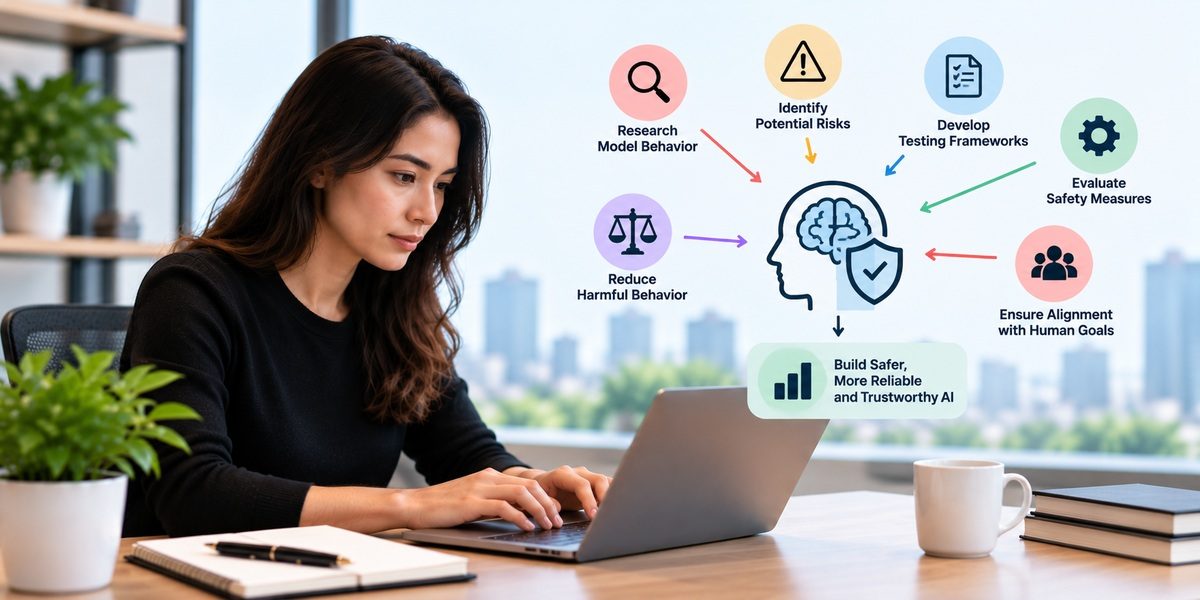
An AI safety researcher studies how artificial intelligence systems can be designed, tested, and deployed in ways that are safe, reliable, and aligned with human goals. They investigate potential risks associated with AI and develop methods to reduce harmful behavior, improve system reliability, and ensure AI systems perform as intended. Their work may involve researching model behavior, evaluating safety measures, developing testing frameworks, and creating techniques to make AI systems more trustworthy.
AI safety researchers work in AI companies, research laboratories, universities, government organizations, and technology firms. They collaborate with AI engineers, machine learning researchers, data scientists, ethicists, and policy experts to address complex safety challenges. Strong analytical thinking, problem-solving skills, curiosity, programming knowledge, and a deep understanding of artificial intelligence are important qualities for success in this role.
What does an AI Safety Researcher do?
Duties and Responsibilities
AI safety researchers are responsible for studying potential risks in AI systems and developing methods to make artificial intelligence safer, more reliable, and more trustworthy.
- AI Safety Research: Conduct research on AI behavior, safety challenges, and potential risks. Explore new techniques that help AI systems operate safely and align with human goals.
- Risk Assessment and Analysis: Identify possible safety concerns, vulnerabilities, and unintended outcomes in AI systems. Analyze how AI models perform in different situations and assess potential impacts.
- Safety Testing and Evaluation: Design tests and evaluation methods to measure the safety and reliability of AI systems. Monitor how models respond to complex, unexpected, or challenging scenarios.
- Development of Safety Techniques: Create tools, frameworks, and methods that improve AI safety. This may include techniques for reducing harmful outputs, improving transparency, or increasing system reliability.
- Collaboration with AI Teams: Work closely with AI engineers, researchers, data scientists, and policy specialists. Share findings and help integrate safety practices into AI development processes.
- Documentation and Knowledge Sharing: Publish research findings, prepare reports, and communicate recommendations to stakeholders. Help organizations understand and apply best practices for AI safety.
Types of AI Safety Researchers
AI safety researchers may specialize in different areas depending on the types of AI systems they study and the safety challenges they address.
- AI Alignment Researcher: Focuses on ensuring AI systems behave according to human goals and intentions. Develops methods to improve the alignment between AI decision-making and human values.
- Generative AI Safety Researcher: Studies the risks and safety challenges associated with generative AI systems such as chatbots, image generators, and large language models. Works to reduce harmful, misleading, or unsafe outputs.
- AI Robustness Researcher: Examines how AI systems perform under unexpected conditions, errors, or adversarial attacks. Develops techniques to make AI models more reliable and resilient.
- AI Interpretability Researcher: Investigates how AI models make decisions and develops methods to better understand their internal processes. Helps improve transparency and trust in AI systems.
- AI Risk and Governance Researcher: Studies the broader risks of AI deployment and develops frameworks for responsible AI development and oversight. Often works at the intersection of technology, policy, and governance.
- Autonomous Systems Safety Researcher: Focuses on the safety of AI-powered systems such as robots, autonomous vehicles, and intelligent agents. Evaluates risks and develops safeguards for real-world AI applications.
AI safety researchers have distinct personalities. Think you might match up? Take the free career test to find out if AI safety researcher is one of your top career matches. Take the free test now Learn more about the career test
What is the workplace of an AI Safety Researcher like?
The workplace of an AI safety researcher is usually found in research labs, technology companies, universities, or specialized AI safety organizations. Their environment is often quiet and focused, with most of their time spent working on computers, reading research papers, running experiments, and analyzing AI model behavior. They use advanced tools and software to test how AI systems respond in different situations and identify potential safety risks.
AI safety researchers work closely with other experts such as AI engineers, machine learning researchers, data scientists, and policy specialists. They regularly attend meetings to discuss findings, share insights, and collaborate on improving AI systems. Communication is an important part of the job because they need to explain complex technical results in a clear way to both technical and non-technical teams.
The work is highly analytical and research-driven. AI safety researchers spend their days designing experiments, testing models, evaluating risks, and developing methods to make AI systems safer and more reliable. Because AI technology changes quickly, they are always learning new techniques, reviewing the latest research, and adapting their approaches to new challenges in the field.
Frequently Asked Questions
Artificial Intelligence-Related Careers and Degrees
AI Careers
Technical & Engineering Roles
- AI Agent Developer
- AI Autonomous Systems Engineer
- AI Cloud Engineer
- Artificial Intelligence Engineer
- AI Infrastructure Engineer
- AI Integration Specialist
- AI Performance Engineer
- AI Platform Engineer
- AI Robotics Engineer
- AI Software Engineer
- AI Solutions Engineer
- AI Systems Engineer
- Computer Vision Engineer
- Edge AI Engineer
- Generative AI Engineer
- Machine Learning Engineer
- MLOps Engineer
- Multimodal AI Engineer
- Natural Language Processing (NLP) Engineer
- Synthetic Data Engineer
AI Product & Design Roles
- AI Accessibility Designer
- AI Creative Technologist
- AI Curriculum Designer
- AI Instructional Designer
- AI Interaction Designer
- AI Learning Experience Designer
- AI Personalization Engineer
- AI Product Designer
- AI Product Manager
- AI UX Designer
- AI Voice Interface Designer
- HAX (Human-AI Experience) Designer
AI Research & Data Roles
- AI Data Analyst
- AI Data Curator
- AI Data Scientist
- AI Evaluation Specialist
- AI Knowledge Engineer
- AI Prompt Scientist
- AI Research Analyst
- AI Research Scientist
AI Strategy, Management & Business Roles
- AI Business Analyst
- AI Change Manager
- AI Consultant
- AI Implementation Specialist
- AI Lifecycle Manager
- AI Product Evangelist
- AI Project Coordinator
- AI Strategist
- AI Workforce Transformation Specialist
AI Ethics, Policy & Governance Roles
- AI Bias Auditor
- AI Compliance Analyst
- AI Compliance Officer
- AI Data Privacy Specialist
- AI Ethics Specialist
- AI Explainability Specialist
- AI Governance Analyst
- AI Governance Specialist
- AI Policy Analyst
- AI Red Team Specialist
- AI Risk Manager
- AI Safety Researcher
- AI Security Specialist
- AI Trust & Safety Specialist
- Responsible AI Specialist
AI Content & Communication Roles
- AI Auditor
- AI Community Manager
- AI Content Writer
- AI Conversation Designer
- AI Literacy Specialist
- AI Localization Specialist
- AI Technical Writer
- AI Trainer
Generative & Creative AI Roles
Industry-Specific AI Roles
- AI Agriculture Specialist
- AI Cybersecurity Specialist
- AI Education Specialist
- AI Financial Specialist
- AI Gaming Specialist
- AI Healthcare Specialist
- AI Legal Specialist
- AI Manufacturing Specialist
- AI Marketing Specialist
- AI Retail Specialist
- AI Supply Chain Analyst
Degrees
AI Safety Researchers are also known as:
Artificial Intelligence Safety Researcher